

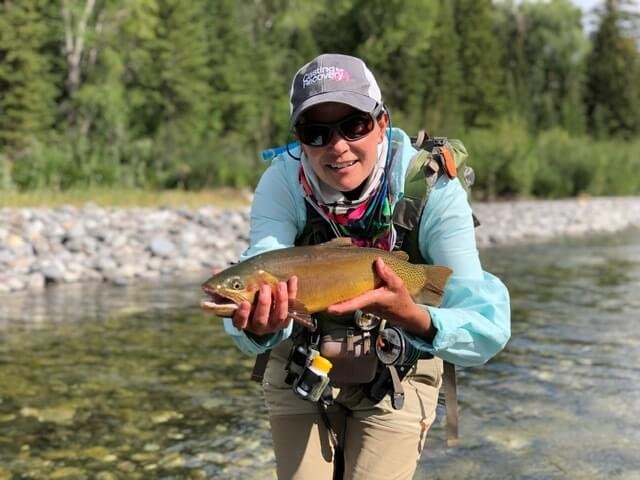
Kay DuShane lives in Pine, Colorado, in the same house she’s called home for 33 years. She didn’t pick up a fly rod until she was well into adulthood, about 30 years ago. Once she did, it took over.
“It just blew my skirt up,” she says. “I loved it.” Up to that point, she had enjoyed plenty of outdoor adventures, but fly fishing became the one that stuck. No regrets.
Her path as a fly fishing guide started roughly 25 years ago at a now-closed Denver shop called the Fly Fisher. She worked the counter and led group trips, including some on private water that ran along stretches of the North Fork of the South Platte. Back then, the property still felt more like a dude ranch. Stream improvements hadn’t yet transformed it into the trout-friendly water it is today.
She guided part-time for various outfitters for years. Around 10 to 15 years ago, female guides were still relatively rare in the fly-fishing world. That scarcity opened doors. One of them led her to Casting for Recovery, the nationwide nonprofit that runs free weekend retreats for women who have faced a breast cancer diagnosis. Those retreats were already being held at North Fork Ranch. Kay began guiding for them on Sundays and got to know the ranch owners and the fishing program. Eventually Jeff (who now runs the guide service) started asking her to guide regular trips for North Fork Ranch Guide Service. She’s been part of the team ever since.
A Day on the Water with Kay
What does a guided day with Kay actually look like?
Trips at North Fork typically run 9 to 5. Kay arrives early, usually between 7:30 and 8, so she can coordinate with other guides if multiple parties are on the water. She greets guests as they arrive, whether they’re day-trippers or lodge guests, and quickly sizes up what they want from the day.
“The easiest trips are with beginners and never-evers,” she says. “Their expectations are a little bit low, and they have less to unlearn.” Intermediates can be tougher. Anglers who fish a lot of public water often arrive with habits that don’t translate well to the North Fork: super-light tippets, long casts, and too much line management. On this river, the key is often moving the angler rather than making them cast farther.
She fits guests with waders and boots from North Fork’s well-organized, high-quality Orvis gear selection. Then it’s down to the water with several rod setups ready. Kay keeps the initial instruction light. She demonstrates in a quiet spot, then builds skills gradually so no one feels overwhelmed.
“I truly believe that people can be successful early on without knowing everything there is to know about fly fishing,” she says. “If they like it, they’ll keep doing it and learn more as time goes on.”
Most days center on nymphing. In Kay’s view, the single most important skill is getting a good drift. That can mean high-sticking to keep line off the water, subtle mending, or simply repositioning one or two steps upstream or downstream. Mind management matters as much as technique, especially for experienced anglers who tend to over-mend.
Favorite Time of Year?
When is the best time to fish the North Fork?
North Fork is highly flow-dependent, controlled largely by Denver Water and the upstream reservoir. There isn’t a single favorite calendar window. It’s more about finding the right flow. The river also isn’t particularly “hatchy,” so success isn’t tied to waiting for a specific bug to come off like clockwork.
Why She Guides
What keeps Kay coming back to guide year after year?
Kay is a part-time guide. What keeps her coming back is watching people learn something new and step outside themselves.
“When I get out on a river, I don’t think about anything else,” she says. “All the noise from out in the world kind of goes away.” That same shift is what she loves seeing in her guests, especially the women she works with through Casting for Recovery. Many of them say it’s the first time in a long while they’ve spent three hours without thinking about treatment or the next appointment.
Fly fishing also flips her own outlook. “I’m sort of cynical in life,” Kay admits, “but fly fishing makes me into an optimist. I think every drift is a possible hit. And what a wonderful thing that is.”
It’s a quiet, steady passion, one that turns skepticism into hope, one careful drift at a time. If you’d like to spend a day on the North Fork with Kay or another member of the team, reach out to North Fork Ranch Guide Service and book your trip.